
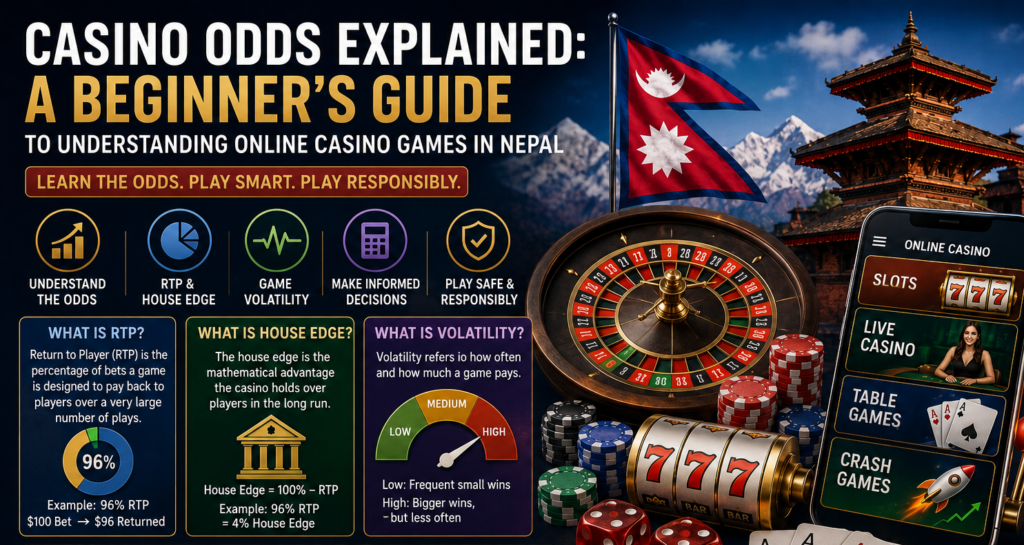
Getting to understand casino odds is perhaps one of the more informative things a beginner to online casino playing can do. This can go some way in explaining a game’s structure, how frequently you might stand to get a return, and mathematically how the casino has a house advantage over the long haul.
Casino odds are nonetheless, not an indicator as to what will transpire within an individual session of play: games with very high theoretical returns can still lead to losses for the player as short term winning could easily occur at a table with less favourable odds and mathematics.
In the following online casino guide, we’ll look at the concepts of RTP, house edge, game volatility, and more in simplified terms.
What Are Casino Odds?
Casino odds refer to the mathematical probabilities of outcomes and rewards available to casino guests from various games.
Slot machines are run with algorithms, roulette works by probability on a spinning wheel, blackjack uses percentages, mathematics from the players’ actions or lack thereof.casino odds help you understand the logic behind why you lose over the long term instead of trying to guess the very last turn or draw of cards.
How Casino Odds Work
Almost all casino games are structured to have an edge for the operator. For instance, let’s say we have a theoretical 96% RTP (return to player) game. In the extremely large sample size required, this would mean that for every 100 placed the theoretical game return is roughly 96.
That remaining 4% would be the theoretical casino edge, otherwise known as the house edge.
Again, this is for large samples, not for an individual playing one session.
What Is RTP?
RTP or ‘Return to player’, one of the most crucial words regarding online casino playing.
This stands for how many percent of your stake it’s programmed to pay back to the players, over a ridiculously large sample.
Take for example:
- RTP: 96%
- Theory stake: $10,000
- Theory pay back: $9,600
The other $400 is the ‘house’s theory’ in terms of profit.
The RTP in any game does not promise you will receive 96% of what you’ve staked back over a single gaming session, in the long run its a matter of winning some more or losing some more on top or below that percent value.
What Is House Edge?
The House Edge refers to the mathematical advantage of any casino game.
The general understanding is that if the game’s theoretical RTP is 96% then its House Edge is around 4%. The formula is generally:
House Edge = 100% − RTP
For example:
| RTP | Theoretical House Edge |
| 95% | 5% |
| 96% | 4% |
| 97% | 3% |
| 99% | 1% |
An inferior house edge is statistically more advantageous to the player however this does not guarantee a winning run.
What Does Game Volatility Mean?
The term game volatility refers to the frequency by which wins occurred in a game.
A game with lower Volatility will award you small sums regularly, whereas a high volatility game might deliver infrequent but higher payments.
To make this clear, let’s say two games offer identical RTP’s; this doesn’t mean they’d make for a very similar gambling encounter.
Game A might distribute a fair few wins within a relatively short frame of time, whereas game B can come for a period where nothing happens until the Jackpot payout materialises.
RTP vs. House Edge: What’s the Difference?
The terms RTP and house edge look at the same thing, from slightly different angels.
RTP: the theoretical return percentage of a player
House Edge: the theoretical retain percentage of the house
After a sufficient number of spins/bets RTP of 97%, implies a house edge of 3%. Both measure statistics over the long run, not the individual outcomes of one bet/spin/hand.
Simple Examples for Beginners
Let’s use the example of a slot with a 96% RTP. If the amount wagered on this slot across millions of spins is $1,000,000, then the amount returned will be close to $960,000 in theory. That doesn’t mean each individual player is given back 96% of what they are individually betting.
In short sessions, one player may win much more and another may lose much more as individual outcomes can differ.
The game of roulette offers a similar principle: There are varied odds and payouts for each of the many betting options in roulette, all contributing to the theoretical hold of the game.
How to Compare Different Casino Games
Choosing casino games Nepal, players may come across should not only be based on money-making potential.
RTP
If the RTP is published, check where it is possible. Most often, the higher the theoretical RTP is, the lower the mathematics house edge.
Volatility
Take some time to consider whether you would prefer frequent small wins to a less frequent, perhaps bigger wins.
Rules
Know how the game works before playing. This is actually very true and really important when playing blackjack or casino blackjack.
Minimum Stakes
See the tables for minimum and maximum bet amounts. Choose betting amounts that fit your defined budget.
Game Conditions
To ensure safety and enjoyment, please review the games’ rules and any related conditions, as well as the relevant payout table, prior to placing bets or making a wager.
Common Misconceptions About Casino Odds
Several myths can lead to poor decisions.
“A game is due to pay”
Losing again does not guarantee a win; a chance outcome does not remember past outcomes.
“Higher bets improve my chances”
Increasing your bet size does not improve the odds Mathematically there is no correlation between higher bets and improved odds of winning.
“My session is predicted by RTP”
A long-term average does not predict the outcome of a short betting session.
“Winning strategy beats every casino”
There is no overall strategy that works when applied to any casino based on a game of chance.
Does a Higher RTP Guarantee Winnings?
No.
The higher the RTP, the lower the house edge theoretically has a bigger chance to pay out over a huge number of rounds.
But it does not mean it will reward you on every spin or every session, it can even give you a huge losing session with just one 98% payout and on the flip side it can pay a small winning one on a quick session even from a 90% payouts game. So let it be a relative factor of comparison not assurance.
Responsible Gaming Considerations
Learning casino odds also means getting acquainted with financial risks too. It is vital to know what’s at stake when you are gambling. Always gamble with money that you are prepared to lose in the worst-case scenario – if something goes south, do not chase your losses by increasing the stake in hope of winning the lost money back.
Besides that, consider this fact too, that you should never play the casino games as a method to earn income.
The legal status of online gaming in Nepal changes ever so often, so, when you see or find any online gaming sites, search the legality associated with playing and accessing such sites in Nepal and proceed if you find no legal issues.
Conclusion
Information on casino odds, RTP, house edge and game volatility would be useful for a beginner when trying to decide what games of chance a person should gamble on at an on-line casino.
RTP states what percentages of any theoretical returns, on any selected game it offers the houseedge, which is a casino’s mathematical advantage while the volatility expresses the probability and size of winnings.
Neither figure offers individual outcomes nor guaranteed any profits so as the houseedge figures show each outcome of play does in fact hold some uncertainty you should play as much as your pockets allow, where it is actually legal to play.
FAQs
What are casino odds?
Casino odds refers to the mathematical probabilities, pay-offs and expected return in casino gaming over a large sample size of play.
What is RTP in casino games?
RTP refers to returning to the player. This is the percentage return of bets a game is theoretically set up to pay back over a significant sample size of play.
What is a house edge?
House edge refers to the mathematical advantage a casino is theoretically supposed to retain.
Is higher RTP always better?
A greater RTP typically correlates with an inferior (for the customer) house edge, although a higher RTP cannot be a guarantee of a particular customer winning.
What is game volatility?
Game volatility refers to how much a game will typically deliver winnings over a sample size of play. More volatile games are usually set to give fewer wins in the short-term, but will usually yield significantly greater losses, or significantly bigger payouts. Less volatile games are those that offer more wins for smaller payout.
Can casino odds guarantee a win?
Casino odds do not. Casino odds cannot possibly affect the randomness.